 Faith & Worship
"Do you not know? Have you not heard? Has it not been told you from the beginning? Have you not understood since the earth was founded? He sits enthroned above the circle of the earth, and its people are like grasshoppers. He stretches out the heavens like a canopy, and spreads them out like a tent to live in." (Isaiah 40:21-22)
 The
Circle is a fairly universal symbol among world religions, though the
context may change. It is seen to represent the sun, the moon, the door
through which we all were born, and the human eye. Since it has no beginning
or end, it easily represents God's love; birth, the Alpha and Omega; eternity,
that which has neither beginning nor end..
The
Circle is a fairly universal symbol among world religions, though the
context may change. It is seen to represent the sun, the moon, the door
through which we all were born, and the human eye. Since it has no beginning
or end, it easily represents God's love; birth, the Alpha and Omega; eternity,
that which has neither beginning nor end..
The circle has become a part of our religious heritage, seen for example
in the rose windows of our cathedrals. Or take the tradition of the Advent
Wreath, which may well have had its origins in a pagan past.
During the dark days of winter, sun-worshippers would burn a cartwheel
to appease the sun god as they prayed for blessings of light and life.
In the Reformation era, seeing the circular wheel as a symbol of the eternal,
unchanging nature of God, Christians may have appropriated this symbol
for their Advent observances. To symbolize God's gift of life, they covered
the wheel with greens, and to symbolize the light brought into the world
by Christ, they added candles.
There is a legend of how St. Patrick when preaching to some soon-to-be
converted heathens was shown a sacred standing stone that was marked with
a pagan circle or wheel, symbolic of the sun or moon goddess. Patrick
made the mark of a Latin cross through the circle and blessed the stone,
effectively creating the first Celtic cross.
It is a nice story but there may be a kernel of historical truth within
it. Certainly it does point to a way in which the early Christian missionaries
sought to Christianize the symbols that were familiar to the people among
whom they were working - not destroying, but using them as a building
block upon which to illustrate and expand their message.
One source suggests that the pagan sun wheel reminded the early Christians
in Ireland of another earlier historic symbol, the wheel cross. The wheel
cross, at least within the Christian community had in turn evolved from
the chi-rho symbol. The Greek letter chi, the first letter in the title
Christ - similar in appearance to the letter "X" - was rotated
until it formed the shape of a cross. The Greek letter rho, the second
letter in the title Christ-similar to the letter "P" - was merged
with the rotated chi, and the whole symbol enclosed in a circle. Eventually
the rho disappeared, leaving a cross in a circle. The combination of standing-stones
with wheel crosses gave us the familiar form of the Celtic Christian high
cross.
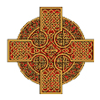
The cross with its characteristic circle is probably the most widely recognized
of all Celtic symbols, emerging as a major sculptural tradition in Ireland,
Scotland and other Celtic lands from the 9th century or earlier.
It might be seen as a criticism of Christianity that wherever its missionaries
have gone they seem to have adopted the pagan or pre-Christian symbols
of the people among whom they were evangelising, and simply pasted over
a Christian meaning - rather as we might paper over the cracks on a wall.
But that would be rather unfair, because the mission of these early Christian
saints was one of transformation. The circle is a shape that is neither
Christian nor pagan, but it is a familiar enough symbol within the natural
world for it to have meaning for all.
Symbols are important, particularly among those who cannot, or have difficulty
expressing their belief system in words. Today we are surrounded by visual
aids, and the media bombards us with images - they are used to reinforce
the spoken and written word. Consider the corporate logo, often costing
millions to design and implement. What does the logo do? A well-designed
one says something about the company that it represents, and is a visual
reminder should we see it on an advertising hoarding of who the company
are and what they stand for.
What better reminder, should we stand in front of a high Celtic Cross
is the circle that speaks of God's love which has no beginning or end
and, despite the pain and suffering of the cross, still continues to be
poured out.
There is another picture we can use of the circle. James, in his letter
(Chapter 2:23) talks about Abraham being called 'A friend of God', and
what greater joy is there to being invited into the circle of friendship
of God?
'On this subject the writer Tozer, in his book Men who met God says this:
It is well for us to remember that Divine-human friendship originated
with God. Had God not first said "You are My friends," it would
be inexcusably brash for any man to say, "I am a friend of God."
But since God claims us for His friends, it is an act of unbelief to deny
the offer of such a relationship....
'The spiritual giants of old were those who at some time became acutely
conscious of the presence of God. They maintained that consciousness for
the rest of their lives....
'The essential point is this: These were men who met and experienced God!
How otherwise can the saints and prophets be explained? How otherwise
can we account for the amazing power for good they have exercised over
countless generations?
'Is it not that indeed they had become friends of God? Is it not that
they walked in conscious communion with the real Presence and addressed
their prayers to God with the artless conviction that they were truly
addressing Someone actually there?'
'A human being is part of the whole, called by us "Universe," a part limited in time and space. He experiences himself, his thoughts and feelings as something separated from the rest - a kind of optical delusion of his consciousness. This delusion is a kind of prison for us, restricting us to our personal desires and to affection for a few persons nearest to us. Our task must be to free ourselves from this prison by widening our circle of compassion to embrace all living creatures and the whole [of] nature in its beauty.'
- Albert Einstein, 1950
1. How important are symbols in your church? When you visit an ancient Christian site can you appreciate the artistry within a carved cross or painted icon? Have you learned to read them as expressions of faith, in an age when few could read, or do you find yourself dismissing them as purely historical artifices?
2. In the story of St Patrick told above, he took a symbol of the pagan beliefs that he found on his missionary journey and Christianised it – the circle dedicated to the sun god became the familiar Celtic cross. We live in what is, in many countries, a secular world filled with symbols of no faith or consumerism. Can you think of any symbols of modern life that could be transformed such that they could tell a different story?
3. In our Pause for Thought, Einstein questions a human’s natural capacity to consider the needs of others and the world, being naturally self-centred. Are Christians different, and if so, why?
©John Birch · Prayers written by the author may be copied freely for worship. If reproduced elsewhere please acknowledge author/website
Privacy Policy · Links · Author · Donate
