 Faith & Worship
"How many are your works, O LORD! In wisdom you made them all..."
(Psalm 104:24)
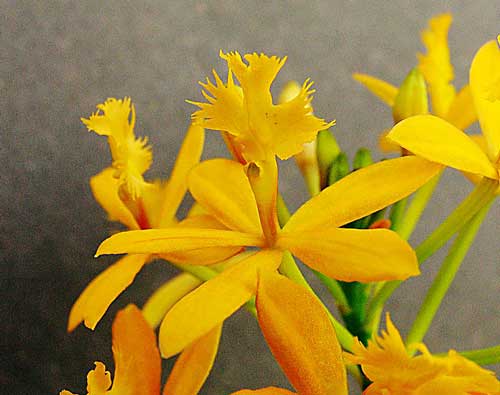
There can be few men who have never given a bunch of flowers
at some point in time to someone that they love. What do the flowers say?
Whatever the giver desires perhaps; but within that gift is surely the
appreciation of beauty, both of the flowers and the one to whom they are
given.
In the UK during the month of November a particular flower, the poppy
becomes the focus of a nation's thoughts. This time it is remembrance,
not of beauty but of horror - of wars fought, battles won and lost and
lives sacrificed for the cause of freedom.
Flowers, of course, were created for neither of these purposes, but simply
to be the means through which reproduction of might take place and the
species continue through to another generation - their colour and complexity
merely the means by which a pollinating insect or bird might be attracted,
and the reproductive process initiated. I say 'merely' but of course the
word is wholly inappropriate when you take into account the sheer wonder
of the variety of different tactics employed by plant and pollinator,
and the delicate balance between the two.
Plants display many wonderful adaptations and mechanisms developed for
the purpose of aiding pollination. Some are entirely dependent upon bees
and other insects, their flowers often possessing special features that
attract insects like colour, odour, and nectar. Others are dependent upon
mammals such as bats or hummingbirds. Or it may be the wind that facilitates
pollen transfer (Imagine pollen floating for hundreds of miles on the
wind currents of the upper atmosphere before reaching a receptive stigma).
Then there are plants which are so designed that only the pollen from
their own stamens can reach their stigma.
Often a plant and pollinator evolve together, adapting to changes in each
other to improve their own survival. The US National Honey Board states
that 'bees may travel as far as 55,000 miles and visit more than 2 million
flowers to gather enough nectar to make just 1 pound of honey'
The picking of flowers is referred to in the Bible only once: "My
beloved has gone to his garden, to the beds of spices, to feed in the
gardens, and to gather lilies" (Song of Songs 6:2). Jesus knew how
to connect with the people to whom he was talking, particularly with the
use of picture language "Consider the lilies of the field, how they
grow; they toil not, neither do they spin; and yet I say unto you, that
even Solomon in all his glory was not arrayed like one of these."
Of all plants in the Bible, the lily is most famous and the one about
which there has been the most differences of opinion. Modern scholars
believe that at least five or six kinds of plants are referred to by that
name. It is thought that one of them was actually yellow flag, an iris
common in the Holy Land. Hebrew botanists have argued that the "lilies
of the field" were actually the chamomile, a small daisy-like plant.
The lilies in the Song of Solomon may well have been the hyacinth with
deep blue, fragrant flowers, native in Palestine and Lebanon.
So having established how wonderful, and indeed useful, are the flowers
that we so often take for granted in our gardens and in the countryside,
what can we gain by looking at them through the lens of our spiritual
eye?
Let's consider ourselves as individuals, created (we believe) by God and
(again, the Bible tells us) in the image of God. That indicates that our
lives radiate elements of God's beauty and creativity. You need to believe
that!
We bear the watermark of our Creator, and just as we might look at the
shear complexity and beauty of an orchid's flower in wonderment so we
must do the same when we consider our own lives.
We are also created fit for purpose, though some, including I may say
many Christians, struggle to come to terms with this. It's not just a
question of self worth. We are bombarded with advertisements, news reports
and documentaries aimed at radically altering both our lifestyle and physical
appearance - and so rarely told that the differences between you and I
are intended and part of the rich tapestry of God's created world.
We find fulfilment and happiness when we can step through the world view,
see ourselves as God intended and rest content with that. I am reminded
of the story about Oliver Cromwell who, when sitting for an artist insisted
that rather than present his portrait as 'perfect' in appearance on the
canvas, which was the accepted practice of the day, that he be painted
as he really was - warts and all.
There is an old Jewish-Christian tradition which says: God sends each person into this world with a special message to deliver, with a special song to sing for others, with an act of love to bestow.
No one else can speak my message, or sing my song, or offer my act of love. These are entrusted only to me. According to this tradition, the message may be spoken, the song sung, the act of love delivered only to a few, or to all the folk in a small town, or to all the people in a large city, or even to all those in the whole world. It all depends on God’s unique plan for each person.
1. Flowers bring to mind many pictures; giving and receiving for example, and the
various emotions that are involved both for the one who gives and the one who
receives – after all, a gift can be refused. There are few things worse for a young
man in love than to have the gift of a Valentine’s rose rejected! Consider just for a
moment the eternal Lover who has gifted so much to his children. How often do we
take all this for granted?
How do we reciprocate?
2. Businesses spend a phenomenal amount of money on trying to persuade us to
change our appearance, either through the purchase of cosmetics or more radically
through surgery. If we look upon this critically as disguising our true appearance, is
it comparable to the way in which people so often hide behind a persona that they
think others will like?
Should we rather rejoice in the differences that mark us out as
human, whether or not they are perceived as desirable?
3. Our ‘Pause for Thought’ suggested that ‘God sends each person into this world with a special message to deliver, with a special song to sing for others, with an act of love to bestow.’
That’s a lovely thought, which fits broadly within the Christian tradition of believing that God has a purpose for each one of us. However, this goes a step further and suggests that there is a unique or special gift for each Christian to deliver depending upon God’s unique plan for each person. How do you feel about this picture of God’s will for his children?
©John Birch · Prayers written by the author may be copied freely for worship. If reproduced elsewhere please acknowledge author/website
Privacy Policy · Links · Author · Donate
